
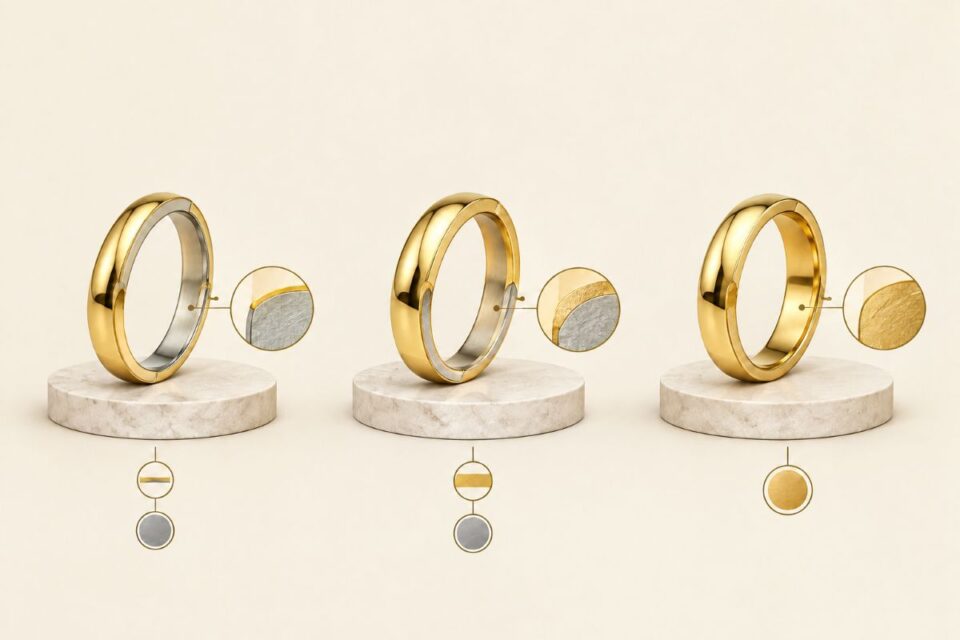
Gold jewellery can look almost identical at first glance, even when the materials and long-term value are very different. The main difference between gold-plated, gold-filled and solid gold jewellery is how the gold is used in the piece: as a surface coating, a thicker bonded layer or the main metal throughout.
Solid gold is generally the best choice for long-term ownership, gold-filled jewellery balances appearance and cost, and gold-plated jewellery is often the most affordable option.
The right choice depends on your budget, how often you plan to wear it and how much maintenance you are willing to do.
Table of Contents
Gold-Plated vs Gold-Filled vs Solid Gold: A Quick Comparison
| Feature | Gold-plated | Gold-filled | Solid gold |
|---|---|---|---|
| Construction | Thin gold coating over another metal | Thicker gold layer mechanically bonded to a base metal | Gold alloy throughout the piece rather than just on the surface |
| Gold content | Surface layer only | Substantial bonded gold layer | Depends on the karat |
| Wear resistance | Coating can wear through | Generally more resistant to wear than ordinary plating | No separate gold coating to wear away |
| Typical cost | Lowest | Middle range | Highest |
| Best for | Affordable fashion jewellery | Frequent wear on a budget | Long-term ownership and fine jewellery |
These are general comparisons, not guarantees. Quality, construction, thickness, workmanship and care all affect how a piece performs.
1. What Is Gold-Plated Jewellery?
Gold-plated jewellery has a thin layer of gold applied to a base metal. The underlying material may be brass, copper, stainless steel or another metal, depending on the product.
The gold coating gives the piece a gold appearance without requiring the manufacturer to use gold throughout. This usually makes gold-plated necklaces, earrings, bracelets and rings more affordable than comparable solid gold designs.
Advantages of gold-plated jewellery
- Affordable: You can try different styles without a large initial investment.
- Wide choice: Gold plating is used for everything from everyday accessories to statement jewellery.
- Lightweight options: The overall weight depends on the base metal and design, but many plated pieces are easy to wear.
- Good for occasional wear: It can be a practical option for special events or accessories you rotate regularly.
The main drawback is wear. Friction, moisture, cosmetics, cleaning products and repeated contact with skin can gradually damage the coating. Once it wears through, the base metal may become visible, changing the jewellery’s colour and appearance.
Gold-plated jewellery can last for different lengths of time depending on its construction and use, so be cautious of sellers promising a fixed lifespan without explaining the plating quality.
Best for: Trend-led designs, occasional wear and buyers who want a gold look at a lower price.
2. What Is Gold-Filled Jewellery?
Gold-filled jewellery has a layer of gold mechanically bonded to a base metal. Unlike ordinary gold plating, the gold layer is generally much thicker, which can make the jewellery more resistant to everyday wear.
In the United States, the Federal Trade Commission’s jewellery guidance describes gold-filled items as having a mechanically applied layer of at least 10-karat gold. The term has specific requirements and should not simply be used as a synonym for gold-plated. See the FTC’s gold jewellery guidance.
A common marking is 1/20 14K GF. This indicates that the item is gold-filled with 14-karat gold, with the fraction referring to the gold layer’s weight relative to the total metal weight under the relevant US convention.
Advantages of gold-filled jewellery
- More substantial gold layer: It generally withstands wear better than conventional thin plating.
- Gold appearance: It can closely resemble solid gold.
- Middle-ground pricing: It costs more than many plated pieces but usually less than a comparable solid gold item.
- Suitable for frequent wear: A well-made piece can be a useful option for people who want to wear gold-coloured jewellery regularly.
Gold-filled jewellery is not solid gold. The core remains a different metal, so the piece does not have the same material composition as solid gold. Its gold layer can also wear or become damaged over time.
The base metal matters, too. If you have a metal allergy, check the full material specification rather than assuming the gold layer makes the entire piece suitable for sensitive skin.
Best for: Buyers who want a more durable alternative to ordinary plating without paying solid gold prices.
3. What Is Solid Gold Jewellery?
Solid gold jewellery is made from a gold alloy throughout the piece, rather than having only a gold coating over a different metal. It is not necessarily pure gold, and it may contain other metals to improve strength, colour and workability.
Gold purity is measured in karats, with 24K representing pure gold. Common jewellery options include:
- 9K gold: 37.5% gold, where this purity is recognised and sold.
- 10K gold: 41.7% gold.
- 14K gold: 58.3% gold.
- 18K gold: 75% gold.
- 22K gold: 91.7% gold.
- 24K gold: Nearly pure gold, depending on the product and applicable standards.
The percentage refers to the gold alloy’s composition, not the percentage of the jewellery’s surface that is gold. The FTC explains the relationship between karat marks and gold purity in its consumer jewellery guide.
Why choose solid gold?
Solid gold has no separate gold-plating layer that can wear away to expose a base metal. It can also be repaired or resized by a qualified jeweller when the design and construction allow it.
However, solid gold is not indestructible. It can scratch, bend or become damaged, and higher-karat gold is generally softer than lower-karat alloys. A solid gold piece may also be hollow, depending on its design, so ask about its construction if weight and strength matter.
Solid gold usually costs more because the material itself contains substantially more gold. Its resale value depends on purity, weight, condition, workmanship and current gold prices; it should not be treated as a guaranteed investment.
Best for: Engagement rings, wedding jewellery, everyday pieces you plan to keep for years, and items you may want repaired or passed down.
4. How Long Does Each Type of Gold Jewellery Last?
There is no single lifespan that applies to every piece. A gold-plated ring worn every day may show wear sooner than plated earrings worn occasionally. A well-made gold-filled chain may last much longer than a poorly constructed one, while solid gold can remain wearable for generations with suitable care and repairs.
The main factors are:
- Frequency of wear: Daily friction affects rings and bracelets more than pieces worn occasionally.
- Gold layer thickness: Thicker coatings generally provide more material before the base metal becomes exposed.
- Contact with chemicals: Perfume, lotions, cleaning products and some cosmetics can affect finishes.
- Construction quality: Clasps, joints, settings and chain links can fail regardless of the metal category.
- Storage and cleaning: Abrasive cleaners and rough storage can damage jewellery.
If longevity is your priority, compare the actual material specification and construction rather than relying on a product’s appearance or a seller’s lifespan claim.
5. How to Identify Gold-Plated, Gold-Filled and Solid Gold
A product description or hallmark can help you understand what you are buying, but no single visual clue proves the metal composition.
Check the markings
Common descriptions include:
- GP or GEP: Often used for gold-plated or gold-electroplated jewellery.
- GF: Often used for gold-filled jewellery.
- 1/20 14K GF: A common gold-filled marking.
- 14K, 18K or 22K: Karat descriptions that indicate gold purity when correctly applied to the gold alloy.
- 375, 585 or 750: Common fineness marks corresponding to 9K, 14K and 18K gold respectively.
Marking practices vary by country, and not every piece carries the same stamps. A karat number on a listing may describe the coating rather than the whole item, so read the complete label.
Look beyond appearance
Colour alone cannot reliably distinguish these materials. A magnet is not a definitive test either, because different base metals and jewellery components react differently.
Look for a clear description of the base metal, gold purity, coating method and any stated thickness or weight ratio. If the purchase is expensive or the description seems inconsistent, ask a reputable jeweller to assess it. Professional testing has limitations, so explain that you want to know whether the piece is plated as well as its gold purity.
6. What About Gold Vermeil?
Gold vermeil is another term worth understanding when comparing jewellery. It generally means gold plating over a sterling silver base, rather than over an unspecified base metal.
Under the US FTC’s jewellery guidance, vermeil has specific requirements for its sterling silver base and gold coating, including a minimum coating thickness equivalent to 2.5 microns of fine gold and gold of at least 10-karat fineness.
This makes vermeil different from ordinary gold-plated jewellery, but it is still a coated product. The gold surface can wear with use, and the sterling silver underneath may eventually become visible.
If you are comparing vermeil with gold-filled jewellery, check the base material and coating details rather than assuming one is always more durable in every situation.
7. Which Type Should You Buy?
The most suitable option depends on how you will use the jewellery.
- Choose gold-plated if you want an affordable accessory for occasional wear or frequently changing styles.
- Choose gold-filled if you want a gold appearance and a more substantial gold layer without the cost of solid gold.
- Choose solid gold if you prioritise long-term ownership, repair options and gold content throughout the piece.
- Consider vermeil if you prefer a gold-coated piece with a sterling silver base.
Before ordering online, check the return policy, seller reputation, material description and care instructions. For sensitive skin, confirm which metals are present in the entire item, including clasps, posts and other components.
Frequently Asked Questions
Is gold-filled jewellery better than gold-plated jewellery?
Gold-filled jewellery generally has a thicker, mechanically bonded gold layer and is more resistant to wear than conventional thin plating. Its actual performance depends on construction, use and care.
Does solid gold mean 100% pure gold?
No. Solid gold jewellery is commonly made from gold alloys such as 14K or 18K. The karat mark indicates the proportion of gold, while the term “solid” describes the item’s construction rather than meaning pure 24K gold.
Can gold-plated jewellery turn your skin green?
It can happen if the coating wears away and the underlying metal reacts with sweat, moisture or skin products. Reactions vary by person and material. If you have sensitive skin, check the base metal and consider a piece with a clearly specified composition.
Is gold-filled jewellery real gold?
Yes. Gold-filled jewellery contains a genuine gold layer bonded to a different metal. However, it is not solid gold throughout, and the gold layer does not make the entire item equivalent to a solid gold piece.
Which type is best for everyday wear?
Solid gold is often a strong long-term choice, while well-made gold-filled jewellery can be a practical lower-cost alternative. The best option also depends on the design, your skin sensitivities, how you care for it and your budget.
Final Thoughts
The difference between gold-plated, gold-filled and solid gold jewellery comes down to construction, gold content, durability and cost. Plated pieces offer an accessible way to enjoy different looks, gold-filled jewellery provides a more substantial gold layer, and solid gold is suited to people who want gold alloy throughout the piece.
Before buying, read the full material description and check the markings. Knowing what sits beneath the gold colour helps you choose jewellery that fits both your budget and how you plan to wear it.